“Journalists Are the First Target After the Military”: Oleksandr Kolychev Told Reporters Without Borders Details of the Attack That Killed His Colleagues

Special correspondent for the Ukrainian international broadcasting channel FREEДОМ, Oleksandr Kolychev, who sustained severe injuries as a result of a Russian drone strike, told the international human rights organization Reporters Without Borders about the circumstances of the tragedy that claimed the lives of his colleagues, Olena Hramova (Hubanova) and Yevhen Karmazin.
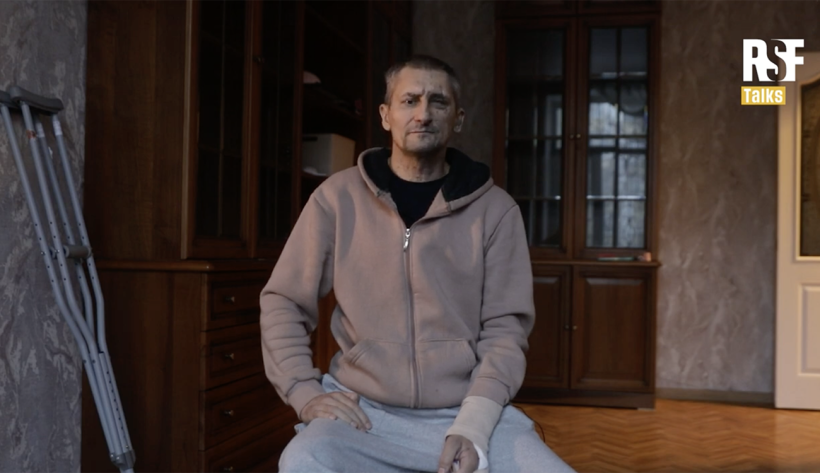
Sharing his experience with human rights defenders, the FREEДОМ special correspondent stated that over the past year, the Russian army’s hunt for media representatives has taken on a systematic and unprecedented character. The occupiers’ use of artificial intelligence and modern digital surveillance tools allows them to deliberately track down filming crews even at a considerable distance from the frontline. Oleksandr is convinced that Russian forces deliberately mark journalists as priority targets immediately after regular units of the Armed Forces of Ukraine in order to clear the space of independent witnesses.
“Artificial intelligence and surveillance tools are improving, communication systems — all of this makes it possible to track even groups entering Donbas or the region and strike them… Journalists, first and foremost, in my opinion, are the first target after the military. Because it is not beneficial for them (the Russians — ed.) for us to cover events, because they can fill this gap with their own information and thus broadcast what they need,” Oleksandr Kolychev shared.
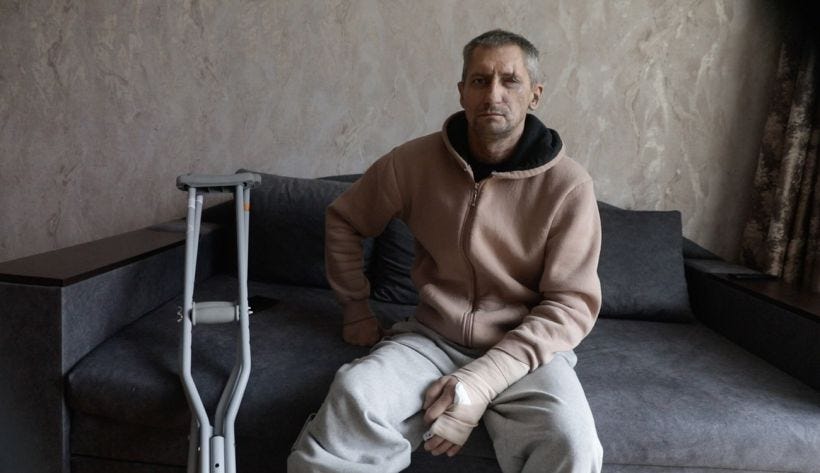
The journalist also recalled the coordinated work of their team on the frontline, where over four years of joint trips every step had been timed down to the second.
“Those who come from other countries or even from other cities do not feel the threat the same way. They are probably more constrained in their actions, while for us it is easier. For example, if it was the first or second line, we had an armored vehicle gifted by volunteers. We would go, for example, to Kostiantynivka to the site of an impact very quickly, filming with three cameras, flying a drone over the site, then quickly getting back in and filming something else while already on the move. It was all very planned, without unnecessary words, without unnecessary words. And that’s how it was for four years,” Oleksandr recalls.
Kolychev learned about the deaths of his colleagues only a week after being hospitalized. He has now endured months of difficult treatment. Oleksandr suffered multiple shrapnel wounds, burns to his face and neck, as well as torn ligaments in his arm. Doctors were forced to remove the journalist’s left eye, and his hearing also remains under threat. Despite everything, Oleksandr Kolychev says that after rehabilitation he wants to remain in the profession:
“If my health allows, I would continue my work as a journalist, and these risks will not stop me. For me, this is not even work — it is interesting and important, which is why we try, and why we will continue covering everything we can, as much as possible.”
Journalists of Ukrainian international broadcasting Olena Hramova and Yevhen Karmazin were killed in a Russian strike on October 23, 2025, in Kramatorsk while carrying out an editorial assignment. Olena Hramova was 43 years old. Yevhen Karmazin was 33. Special correspondent Oleksandr Kolychev was taken to hospital in critical condition.
The President awarded journalists of Ukrainian international broadcasting — Olena Hramova, Yevhen Karmazin, and Oleksandr Kolychev — with state honors for their contribution to the fight for truth and freedom of speech. Alona Hramova and Yevhen Karmazin were posthumously awarded the National Prize for the Protection of Freedom of Speech. Secretary General of the Council of Europe Alain Berset, reacting to the killing and injury of FREEДОМ journalists in Kramatorsk, stated that he “honors their courage and reaffirms commitment to truth, justice, and freedom of the press.”
The full video “When Journalists Become Targets — Oleksandr Kolychev’s Story About Journalism in Ukraine” can be viewed at the following link